We're going backwards

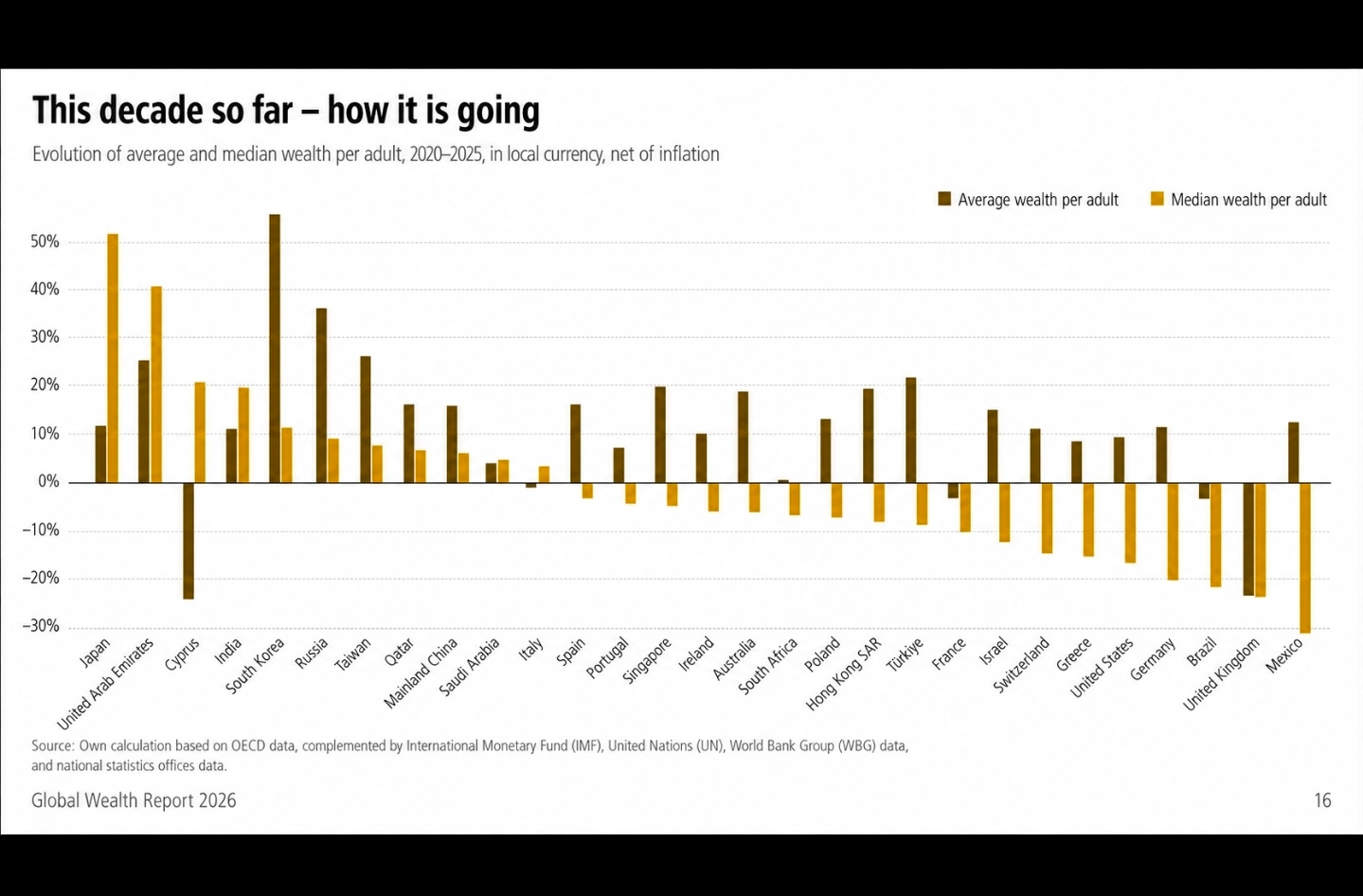
This chart is hidden within the latest UBS Global Wealth Report and I think it's incredibly revealing.
It shows how both the average wealth and median wealth for multiple countries have faired against inflation over the past five years, and while there are countless variables in play, I believe this tells a story about asset wealth.
The majority of the world has seen demonstrable rises in average wealth, a figure that is far more easily distorted by an increase in wealth consolidated within an ultra-wealthy minority. This is because the wealthier someone is, the greater portion of their wealth that usually exists in properties or shares.
The median wealth, meanwhile, provides a more accurate representation of how the middle class is fairing, and the story is the same across the planet. Perhaps most prominently, that story tells us that most of those living across Australia, Europe, and the USA, are going backwards.
Japan is the outlier (as is the UAE and Cyprus, however, their significant foreign born population makes them less useful to study).
The obvious variable here is property prices. Following a huge property bubble in Japan, median house prices have effectively flat lined for the past 30 years, as did the stock market, with the Nikkei only surpassing its 1989 high in 2024.
This is unimaginable for most of the Western World, with property prices and stock markets both witnessing a close to 100% return over the past decade alone.
So what about China?
After their massive property bubble burst in 2021, house prices are still around 20% below their peak. This was a genuine economic calamity for millions of Chinese who had leveraged their entire savings on investment properties they were convinced would fund their retirement.
It is now estimated that China has over 80 million vacant homes, inducing a remarkable period of 0% inflation as a generation of Chinese nervously hold on to their savings rather than spend it. The result is a narrowing of the wealth gap, but with the CPI occasionally even dropping into the negative, it also demonstrates broad wealth stagnation.
A mature policy debate needs to look well beyond these headline figures before using them to advance the arguments we already believe in. We can see, factually, we are on the wrong path. We have a vanishing window to change course.
Immigration is absolutely a factor, with both Japan and China experiencing rapid population decline. But the immediate impact on home prices already seen in Australia as a result of small changes to asset tax discounts suggest that there are other levers to pull before we recklessly cut our economy off from the skilled workforce it needs to grow.
Cutting back on immigration concerns me greatly in Australia. aged care, community care, cleaning services (hospitals, airports, schools, office towers, roads and streets), hospitality and food services (kitchens, cooking, takeaway, delivery), agriculture: meat processing, especially poultry processing, fruit picking, dairy support, vineyards, packing sheds, remote and seasonal agriculture.
Construction: bricklaying, tiling, painting, plastering.
Transport: delivery, couriers, forklift, night packing. And then there’s all the skilled migrants in medicine and other sciences, engineering, IS and much more.
Brexit, what a disaster. We have problems the UK is completely screwed.