A warning shot?

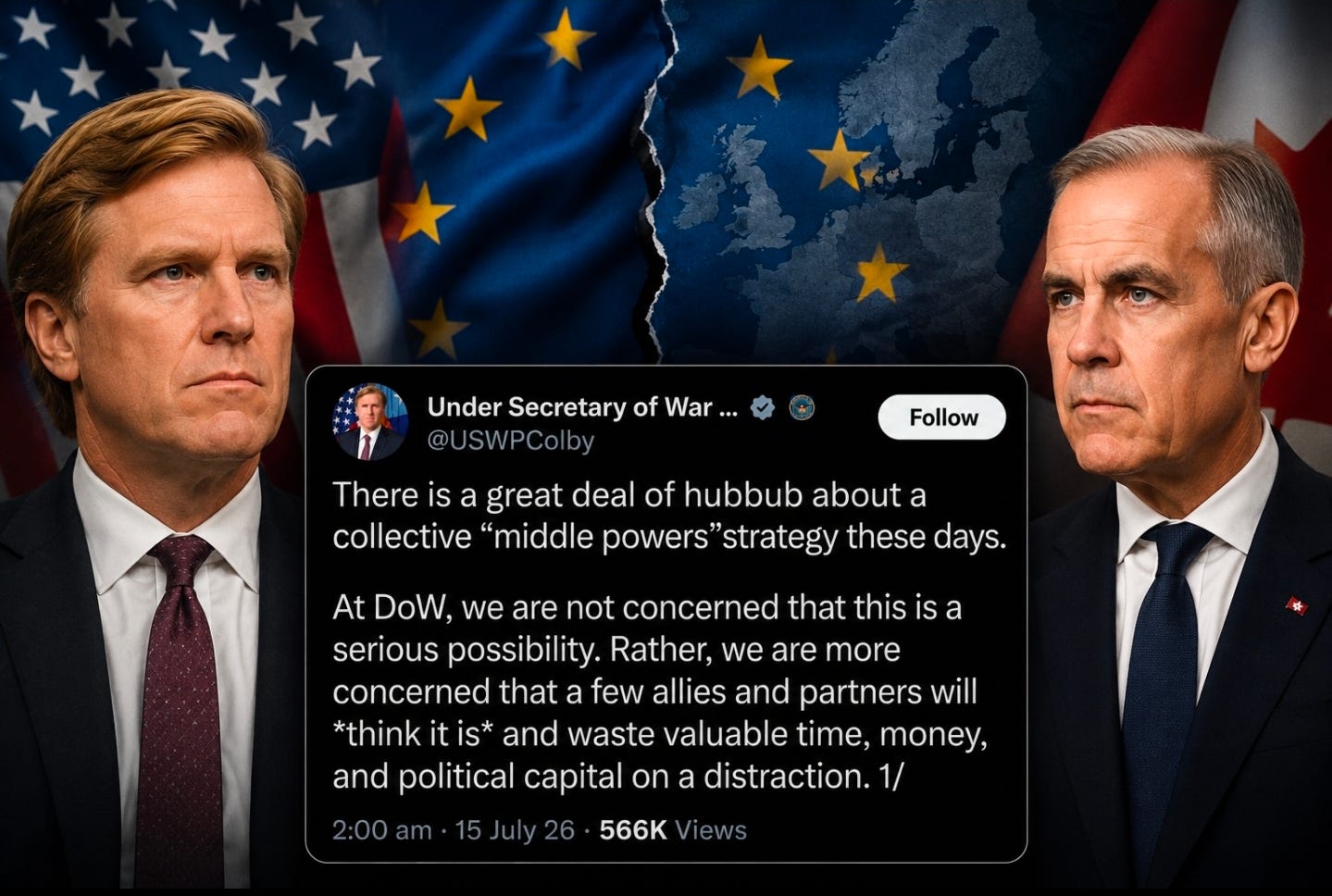
Elbridge Colby, the U.S. Under Secretary of Defense for Policy, just posted a thread on X which I think is incredibly revealing, and worth reading in full.
Colby is incredibly influential within the Trump administration, effectively the Pentagon’s chief strategist and principal adviser on defence and foreign policy. He is also the man in charge of reviewing AUKUS.
I’ll share his full post below and then add my thoughts. (DoW = Department of War, DIB = Defence Industrial Base)
...
“There is a great deal of hubbub about a collective “middle powers”strategy these days.
At DoW, we are not concerned that this is a serious possibility. Rather, we are more concerned that a few allies and partners will think it is and waste valuable time, money, and political capital on a distraction.
From our point of view, a collective middle powers strategy is based on a faulty understanding of international relations. We are flexible realists. So, we view the international scene through the prism of interest, geography, economics, military power, etc. “Middle powers” don’t have a coherent basis for alignment.
It also isn’t borne out by reality, in our experience. We see an upsurge in desire for engagement with the United States, not a reduction. Under President Trump’s leadership, countries not only see the value of American engagement, they can no longer take it for granted. We unquestionably see an incredibly strong and continuing demand signal for U.S. military presence and engagement around the world.
Take our defense industry and arms sales. There is a lot of commentary that, due to alleged frustrations with the United States, the American defense industrial base will lose out on the market for weaponry. But this is neither feasible nor accurate.
The simple fact of the matter is that no alternative country or countries can compete with the U.S. defense industrial base, either in quantity or quality. The United States, as the President says, makes the best equipment, and we make it at a scale that no plausible competitor can match. If anything, access to the American DIB is a privilege, not a right.
At the same time, American companies are at the forefront of advanced technology. There is no credible free world alternative to American tech and its implications for defense.
This is not to say allies and partners should give up spending more or investing in their own DIB. To the contrary. More spending will help us all, and especially our allies’ own security. And we welcome allies’ investment in their own DIBs, but in ways that are collaborative with America’s rather than trying in vain to replicate or supplant it.”
...
To start with, Colby is correct in recognising the superiority of the USA’s defence manufacturing capability. It has spent so much on its arms manufacturing over the past few decades that no other nation on earth has its capabilities or expertise.
Not withstanding the rapidly evolving nature of drone warfare, there are still many capabilities that the USA can produce that no other can.
However... this line really jumped out at me:
“ “Middle powers” don’t have a coherent basis for alignment.”
This is the fundamental aspect of our relationship with the USA that Colby and other “America First” foreign policy ideologues don’t grasp. The middle powers of the Western World didn’t align with the USA because of their military supremacy, but because of shared values.
As Carney intimated in his Davos speech, we have always known that the rules of the Rules Based Order were not applied equally to all, but there was, at least, a shared commitment to the rules. The USA under Trump has openly celebrated its indifference to the global order they helped establish, and rested the legitimacy of their actions upon the fact that no one could stop them.
This is where the distinction between fear and respect is an incredible important one to understand.
It will be a costly process to disentangle our military from the USA, but it is necessitated but a rapid collapse in trust. This is now an urgent matter of strategic autonomy.
For a nation like Australia, Colby articulates the delicate paradox confronting our government. To achieve security in a multi-polar world, Australia’s military must attain advanced technology with capabilities that exceed those within our region. The USA, through AUKUS, has provided us with that pathway.
Yet, politically and ideologically, our nations are drifting apart.
This feels like a shot across the bow from Colby to any Middle Power attempting to leave what feels like a toxic relationship, reminding us that we are not yet strong enough to defend ourselves alone, while warning us not to try and do it alone.
It demonstrates why the West must walk away from Washington without breaking eye contact... and without the emotional release of declaring our departure.
You are correct: Colby is making a threat - but it is based on hubris, not a measured assessment of reality. Like any playground bully, he is assuming all he need do is murmur “nice world you’ve got here - be a shame if anything happened to it”. But America remains only a small part of the world, and much of the unrest and turmoil is of American manufacture.
Given the behaviour of projecting and threatening, my take is that their backsides have started to twitch at the loss of income to their warmongering budget KPIs and they talk themselves up as indispensable. The reaction to Carney’s speech will create new industries and agreements that money will flow to to create those new manufacturing hubs. I’m truly hoping that leadership in these middle countries can stay calm and not buy into the rhetoric - the payoff with dealing with such an unhinged regime is that people keep getting shafted and like us, it costs billions. They keep changing the goal posts and that’s not manageable. Also, what’s our refund from the tariffs? Has that invoice been sent yet?